The proteasome is widely recognised as the central enzyme of non-lysosomal protein degradation. It is responsible for intracellular protein turnover and it is also critically involved in many regulatory processes and, in higher eukaryotes, in antigen processing. The 26S proteasome is the key enzyme of the ubiquitin/ATP-dependent pathway of protein degradation. The catalytic core of this unusually large (2000kDa, 450Å in length) complex is formed by the 20S proteasome, a barrel shaped structure shown by electron microscopy to comprise of four rings each containing seven subunits.
Based on sequence similarity, all fourteen 20S proteasomal subunit sequences may be classified into two groups, α and β, each group having distinct structural and functional roles. The α-subunits comprise the outer rings and the β-subunits the inner rings of the 20S proteasome. Observations of the eukaryotic proteasome and analysis of subunit sequences indicate that each ring contains seven different subunits (α7β7β7α7) with a member of each sub-family represented in each particle. Each subunit is located in a unique position within the α- or β-rings. 120S Proteasomes degrade only unfolded proteins in an energy-independent manner, whereas 26S proteasomes degrade native and ubiquitinylated proteins in an ATP-dependent manner. The native protein substrates are recognised by subunits, some with ATP binding sites, of the outer 19S caps of the 26S proteasome.
Shipping: Available products typically ship within 24/48h, via priority shipping.
Do you need support? Contact Customer Service or Technical Support.
Online Account
Access or Create Your Account
This antibody is covered by our Worry-Free Guarantee.
Product Details
| Application |
IHC (FS), IP, WB |
|---|---|
| Application Notes |
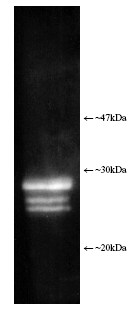
Western blot – The antibody has been characterised by single dimension SDS-PAGE using both purified human and yeast 20S proteasome and a number of tissue/cell preparations including a human placental proteasome preparation, a HeLa cell lysate, a RSV 3T3 mouse fibroblast cell lysate, and a yeast whole cell extract. Western blotting shows bands attributable to ‘core’ subunits at ~25-30kDa as shown opposite. Differences in subunit band intensity are noted between the samples. 2-D SDS-PAGE followed by Western blotting of purified 20S proteasome shows the presence of five/six spots with the following proteasome subunit correlation: α5/α7, β1, β5, β5i, β7. The 2-D patterns observed with human and mouse derived materials are not identical with some differences being observed in the molecular weights and isoelectric points of some subunits. |
| Formulation |
Liquid. In PBS containing 10mM sodium azide. |
| Host |
Rabbit |
| Immunogen |
Human erythrocyte-derived proteasomes. |
| Source |
From rabbit serum. |
| Species Reactivity |
Human, Mouse, Rabbit, Rat, Yeast |
| Specificity |
Recognizes the ‘core’ subunits of the 20S proteasome. |
| Worry-free Guarantee |
This antibody is covered by our Worry-Free Guarantee. |
Handling & Storage
| Use/Stability |
Dilute with PBS pH 7.2 – 7.4 and 1% normal goat serum (if a goat anti-rabbit IgG linker antibody is to be used). |
|---|---|
| Handling |
Avoid freeze/thaw cycles. Aliquot undiluted antibody into smaller volumes (not less than 10µl) prior to freezing if appropriate. The use of high quality ‘antiserum-grade’ plastic or glass vials is recommended. Dilute to working strength with phosphate buffered saline pH 7.2-7.4 and 1% normal goat serum (if a goat anti-rabbit IgG linker antibody is to be used). Store diluted antibody at +2-4°C (do not freeze) and use within 1 month. |
| Long Term Storage |
-20°C |
| Shipping |
Blue Ice |
| Regulatory Status |
RUO – Research Use Only |
|---|
- Protective mechanisms against Alzheimer’s disease in APOE3-Christchurch homozygous astrocytes.: Tian, X., Rivera, E. K., et al.; Alzheimers Dement. 21, e70589 (2025), Abstract
- Gain and loss of the centrosomal protein taxilin-beta influences cardiac proteostasis and stress.: McLendon, J. M., Zhang, X., et al.; J. Mol. Cell. Cardiol. 201, 56 (2025), Abstract
- Protective mechanisms against Alzheimer’s Disease in APOE3-Christchurch homozygous astrocytes: Tian, X., Rivera, E. K., et al.; bioRxiv , (2025), Reactant(s): Human
- Reserpine maintains photoreceptor survival in retinal ciliopathy by resolving proteostasis imbalance and ciliogenesis defects.: Chen, H. Y., Swaroop, M., et al.; Elife 12, (2023), Application(s): WB, Abstract
- Proteolytic markers associated with a gain and loss of leg muscle mass with resistance training followed by high-intensity interval training: Michel, J. M., Godwin, J. S., et al.; Exp. Physiol. 108, 1268 (2023), Abstract
- The molecular network of the proteasome machinery inhibition response is orchestrated by HSP70, revealing vulnerabilities in cancer cells: M. Oroń, et al.; Cell Rep. 40, 111428 (2022), Abstract
- Antioxidant Molecular Brain Changes Parallel Adaptive Cardiovascular Response to Forced Running in Mice.: Bartra, C., Jager, L. A., et al.; Antioxidants (Basel) 11, (2022), Application(s): WB / Reactant(s): Mouse, Abstract
- Survivin suppression heightens BZML-induced mitotic catastrophe to overcome multidrug resistance by removing therapy-induced senescent A549/Taxol cells: Z. Bai, et al.; Biochim. Biophys. Acta Mol. Cell Res. 1869, 119174 (2021), Abstract
- The response network of HSP70 defines vulnerabilities in cancer cells with the inhibited proteasome: Zylicz, A., Walerych, D., et al.; bioRxiv , (2021), Application(s): IP / Reactant(s): Human
- Homeostatic scaling is driven by a translation-dependent degradation axis that recruits miRISC remodeling: Srinivasan, B., Samaddar, S., et al.; PLoS Biol. 19, e3001432 (2021), Abstract
- Resveratrol confers neuroprotection against high-fat diet in a mouse model of Alzheimer’s disease via modulation of proteolytic mechanisms: Sarroca, S., Gatius, A., et al.; J. Nutr. Biochem. 89, 108569 (2021), Abstract
- Immobilized Antibodies on Mercaptophenylboronic Acid Monolayers for Dual-Strategy Detection of 20S Proteasome: M.M. Barsan, et al.; Sensors 21, 2702 (2021), Abstract — Full Text
- Novel functions of the ubiquitin-independent proteasome system in regulating Xenopus germline development: Hwang, H., Jin, Z., et al.; Development 146, (2019), Abstract
- Mass spectrometry-based absolute quantification of 20S proteasome status for controlled ex-vivo expansion of Human Adipose-derived Mesenchymal Stromal/Stem Cells: T. Menneteau, et al.; Mol. Cell. Proteomics 18, 744 (2019), Application(s): ELISA based quantification of 20S proteosome in human 293-EBNA cells expressing 20S proteosome, Abstract
- CagA Effector Protein in Helicobacter pylori-Infected Human Gastric Epithelium in Vivo: From Bacterial Core and Adhesion/Injection Clusters to Host Cell Proteasome-Rich Cytosol: Necchi, V., Ricci, V., et al.; Toxins (Basel) 11, (2019), Abstract
- Chemical proteasome inhibition as a novel animal model of inner retinal degeneration in rats: M. Kageyama, et al.; PLoS One 14, e0217945 (2019), Abstract — Full Text
- Susceptibility of microtubule-associated protein 1 light chain 3β (MAP1LC3B/LC3B) knockout mice to lung injury and fibrosis.: Seeger, W., Ochs, M., et al.; FASEB J. 33, 12392 (2019), Application(s): WB / Reactant(s): Mouse, Abstract
- Shifting the balance of autophagy and proteasome activation reduces proteotoxic cell death: a novel therapeutic approach for restoring photoreceptor homeostasis.: Qiu, Y., Yao, J., et al.; Cell Death Dis. 10, 547 (2019), Application(s): WB / Reactant(s): Mouse, Abstract
- Inhibiting autophagy reduces retinal degeneration caused by protein misfolding.: Yao, J., Qiu, Y., et al.; Autophagy 14, 1226 (2018), Reactant(s): Mouse, Abstract
- Mutant UBQLN2 promotes toxicity by modulating intrinsic self-assembly.: Sharkey, L. M., Safren, N., et al.; PNAS 115, E10495 (2018), Application(s): IHC-IF, Abstract
- Modifications of the 26S proteasome during boar sperm capacitation.: Zigo, M., Kerns, K., et al.; Cell Tissue Res. 372, 591 (2018), Application(s): FC/FACS / Reactant(s): Peanut, Abstract
- TRIM11 activates the proteasome and promotes overall protein degradation by regulating USP14: L. Chen, et al.; Nat. Commun. 9, 1223 (2018), Abstract — Full Text
- Cyt/Nuc,” a Customizable and Documenting ImageJ Macro for Evaluation of Protein Distributions Between Cytosol and Nucleus”””: T. Grune, et al.; Biotechnol J. 13, 1700652 (2018), Abstract
- Acetylation-induced TDP-43 pathology is suppressed by an HSF1-dependent chaperone program.: Cohen, T. J., Wang, P., et al.; Nat. Commun. 8, 82 (2017), Application(s): IHC-IF, Abstract
- Natural history of Helicobacter pylori VacA toxin in human gastric epithelium in vivo: vacuoles and beyond: Necchi, V., Sommi, P., et al.; Sci. Rep. 7, 14526 (2017), Abstract
- Human Antiviral Protein IFIX Suppresses Viral Gene Expression during Herpes Simplex Virus 1 (HSV-1) Infection and Is Counteracted by Virus-induced Proteasomal Degradation.: M.S. Crow & I.M. Cristea; Mol. Cell. Proteomics 16, S200 (2017), Application(s): Immunoaffinity purifications, WB and immunofluorescence , Abstract
- Uncovering the SUMOylation and ubiquitylation crosstalk in human cells using sequential peptide immunopurification: F. Lamoliatte, et al.; Nat. Commun. 8, 14109 (2017), Abstract — Full Text
- The Molecular Chaperone Hsp70 Promotes the Proteolytic Removal of Oxidatively Damaged Proteins by the Proteasome: S. Reeg, et al.; Free Radic. Biol. Med. 99, 153 (2016), Application(s): WB / Reactant(s): Mouse, Abstract
- D1 dopamine receptor stimulation impairs striatal proteasome activity in Parkinsonism through 26S proteasome disassembly: P. Barroso-Chinea, et al.; Neurobiol. Dis. 78, 77 (2015), Application(s): Immunocytochemistry, Western Blotting, Abstract
- Proteomic identification of hair cell repair proteins in the model sea anemone Nematostella vectensis: P.C. Tang, et al.; Hear. Res. 327, 245 (2015), Application(s): Inhibition experiments, Abstract
- Deciphering preferential interactions within supramolecular protein complexes: the proteasome case.: Fabre, B., Lambour, T., et al.; Mol. Syst. Biol. 11, 771 (2015), Abstract
- Nuclear proteasomes carry a constitutive posttranslational modification which derails SDS-PAGE (but not CTAB-PAGE): D.S. Pitcher, et al.; Biochim. Biophys. Acta 1844, 2222 (2014), Abstract
- Proteolipidic composition of exosomes changes during reticulocyte maturation.: Joly, E., Bertrand-Michel, J., et al.; J. Biol. Chem. 286, 34426 (2011), Application(s): WB, Abstract
- TRIM5α associates with proteasomal subunits in cells while in complex with HIV-1 virions: Z. Lukic, et al.; Retrovirology 8, 93 (2011), Abstract — Full Text
Related Products
| Application | ICC, IHC, WB |
|---|---|
| Host | Rabbit |
| Species Reactivity | Human |
| Alternative Name | Activating transcription factor 6 |
|---|---|
| Application | ChIP, ICC, IHC (PS), IP, WB |
| Host | Mouse |
| Isotype | IgG1 |
| Species Reactivity | Hamster, Human, Mouse, Rabbit, Rat |
| Alternative Name | p28 BAP31, B cell receptor-associated protein BAP31, BCR-associated protein BAP31, CDM, DXS1357E, 6C6-AG tumor-associated antigen, BCAP31 |
|---|---|
| Application | ELISA, Flow Cytometry, ICC, IHC (FS), IP, WB |
| Host | Mouse |
| Isotype | IgG2a |
| Species Reactivity | Human, Monkey |
| Alternative Name | Blm3, PA200 homolog |
|---|---|
| Application | WB |
| Host | Rabbit |
| Species Reactivity | Saccharomyces cerevisiae |
Last modified: May 29, 2024
Datasheet, Manuals, SDS & CofA
Manuals And Inserts
Certificate of Analysis
Please enter the lot number as featured on the product label
SDS
Enzo Life Science provides GHS Compliant SDS
If your language is not available please fill out the SDS request form
Lab Essentials
AMPIVIEW® RNA probes
Enabling Your Projects
GMP Services
Bulk Solutions
Research Travel Grant
Have You Published Using an Enzo Product?